
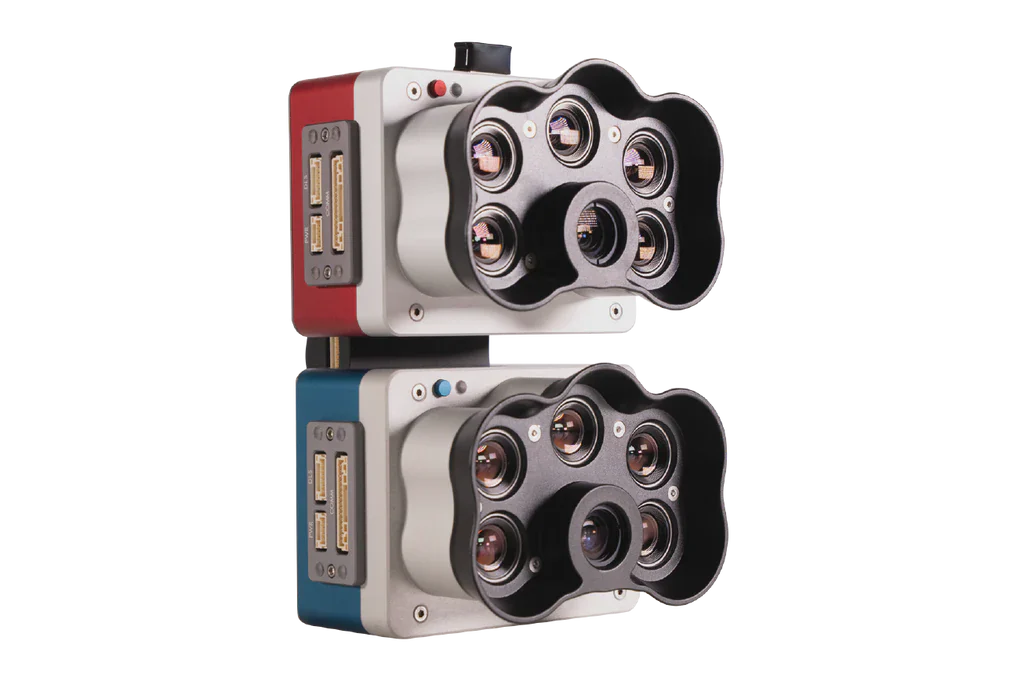
MicaSense RedEdge-P Dual — 10-Band Multispectral Imaging

Expanded Spectral Information for Advanced Research

Two coordinated RedEdge-P sensors extend spectral coverage for research, habitat mapping and customised classification.

RedEdge-P Dual combines two RedEdge-P spectral configurations in one coordinated system. A common Blue Dual configuration pairs Standard and Blue sensors for ten multispectral bands. Other combinations require configuration-specific review; the product name alone does not define every wavelength.

Technical content updated 17 November 2026 · checked against official manufacturer sources
MicaSense RedEdge-P Dual stacked Standard and Blue ten-band multispectral sensor assembly
RedEdge-P Dual Standard + Blue configuration. Manufacturer product image distributed through a sales channel.
02coordinated sensors
10multispectral bands
PANpanchromatic capability
CUSTOManalysis-ready planning

RedEdge-P Dual specifications and workflow context

Manufacturer specifications are shown with their acquisition or processing conditions. Confirm the current configuration and intended outputs before procurement.

01
Architecture

Two coordinated RedEdge-P sensors

02
Multispectral imaging

10 bands

Exact wavelengths depend on the selected pair
03
Common configuration

Standard + RedEdge-P Blue

Often described as Blue Dual; confirm the supplied configuration
04
Panchromatic imaging

RedEdge-P family capability

Output handling depends on configuration and software
05
Processing

PIX4Dfields lists RedEdge-P Dual support

Verify file handling and intended outputs against the installed version
06
Integration review

Payload, mount, synchronisation, calibration and storage

Assess as one complete airborne system

Specify the output before the payload.

Combines two coordinated spectral configurations; integration and processing require more planning.

Research institutes, ecological consultancies and advanced agricultural teams with a defined use for ten bands and the capacity to validate a more complex processing chain.

Review the intended configuration

What changes in the field and in processing.

The practical reasons to choose RedEdge-P Dual, with the integration and interpretation boundaries kept visible.

01

01 / TEN-BAND DECISION

Add wavelengths for a defined analytical reason.

A ten-band system can support research questions that a conventional five-band sensor cannot address directly. The extra measurements may help investigate pigments, canopy conditions or land-cover classes, but more bands do not automatically produce a more accurate or useful model.

  • Start with the target variable and validation method
  • Map each required index to an available wavelength
  • Test whether the additional bands improve the intended result
02

02 / COORDINATED ACQUISITION

Treat synchronisation and radiometry as system requirements.

Two sensors must operate as a coherent dataset. Mounting, triggering, geotagging, time alignment, incident-light measurement and reflectance-panel procedures all affect whether corresponding bands can be compared reliably.

  • Verify capture synchronisation and image association
  • Apply the correct calibration references to both sensors
  • Check band alignment before deriving indices or training classifiers
03

03 / PROCESSING PATH

Separate supported mosaic production from custom science.

PIX4Dfields documentation lists RedEdge-P Dual as a supported camera, which establishes a documented processing route for supported files. Advanced classification, research indices and model development may still require GIS, remote-sensing or scientific software outside the agricultural mapping application.

  • Document required raster and index outputs
  • Test representative files before procurement
  • Plan custom processing only where the research method requires it

Where this sensor can contribute.

Representative application contexts, not claimed Easepect customer outcomes. Suitability depends on the target, acquisition design, processing method and validation.

01

Crop classification research

Develop and validate class-specific spectral methods with ground reference data.

Discuss this application
02

Salt marsh and wetland studies

Combine spectral information with field observations or complementary surface measurements.

Discuss this application
03

Pigment investigations

Use appropriate wavelength combinations for research indices and ecological interpretation.

Discuss this application
04

Algorithm development

Build richer training datasets while controlling alignment, calibration and class labels.

Discuss this application

Who should consider RedEdge-P Dual?

Research institutes, ecological consultancies and advanced agricultural teams with a defined use for ten bands and the capacity to validate a more complex processing chain.

The exact band set depends on the two selected RedEdge-P configurations. Additional spectral measurements do not independently establish plant species, biomass, nutrients or stress causes.

Questions to resolve before selecting RedEdge-P Dual.

That depends on the selected pair. A common Blue Dual configuration combines Standard and Blue RedEdge-P sensors. Request the exact band table for the proposed assembly before procurement.

Verify the exact camera and processing configuration.

Manufacturer and channel imagery illustrates the referenced hardware. Supply scope, price, stock, warranty and availability are confirmed separately.

Specify RedEdge-P Dual around the outputs you actually need.

Share the application, drone platform, project area, required data products and timeline. Easepect can discuss the current configuration, technical demonstration, integration and training without assuming universal software support or project results.