CAD and BIM
Connect building geometry, plans and model-related information to facility records where the agreed workflow requires it.
 Get a quote
SPEEDIKON C / ENTERPRISE CAFM + IWMS
Connect buildings, assets, spaces, maintenance activities and operational information through one integrated facility management platform.
A structured environment for managing complex buildings, property portfolios and technical infrastructure across technical, commercial and infrastructural operations.
01 / WHY SPEEDIKON C
Buildings generate enormous amounts of information throughout their operational life. A reliable operating picture depends on connecting that information to responsibilities and action.
Asset specifications may be stored in spreadsheets, maintenance records in separate applications, building drawings in CAD files and service requests in emails. This fragmentation makes it difficult to establish a reliable overview of facility conditions and operational responsibilities.
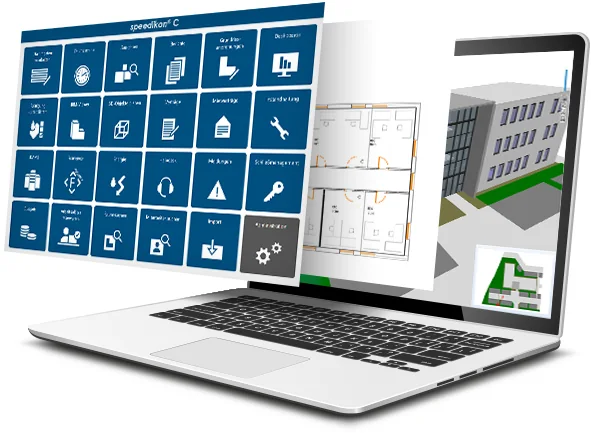
speedikon C connects these information sources and workflows within a shared management environment. From asset registers and preventive maintenance to space allocation, contract administration and operational reporting, it helps organisations build a reliable foundation for informed facility-management decisions.
Easepect Technologies supports organisations in Singapore with solution assessment, implementation planning and the integration of facility-management workflows.
02 / COMPLETE SOFTWARE MODULE CATALOGUE
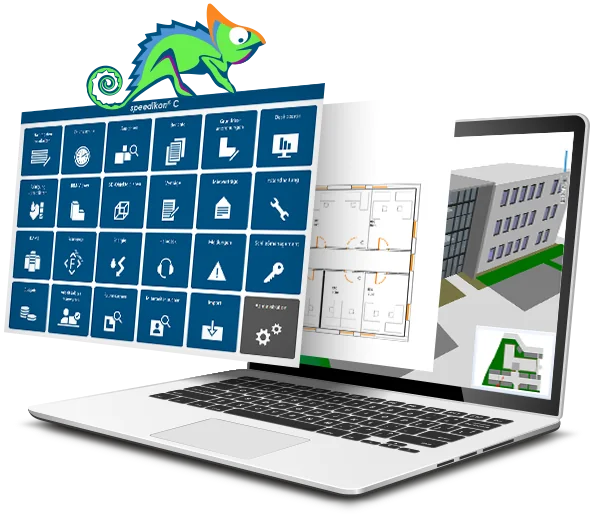
Explore the three facility-management domains. Module selection, licensing and configuration should be confirmed against your operating requirements; this catalogue does not imply that every capability is included in every licence.

A / 08 MODULES
Coordinate assets, maintenance, service requests, condition and operational resources.
Plan preventive maintenance, inspections, repairs and recurring service activities. Connect maintenance schedules, equipment information, work instructions and completed records to individual assets.
Create, allocate, monitor and close work orders involving internal teams or external service providers. Track responsibilities, completion status, supporting documents and work history.
Provide a structured workflow for reporting faults, requesting services and managing incidents. Create clear visibility of who is responsible for each request and its current status.
Maintain structured records for equipment and building systems, including location, condition, technical information and related documentation.
Document the condition of buildings, components and technical systems to support maintenance prioritisation, refurbishment planning and long-term investment decisions.
Manage warranty information, expiry dates, related assets and documentation so that coverage can be reviewed alongside maintenance and lifecycle records.
Connect energy and resource consumption information to buildings, assets and operational activities for monitoring, analysis and optimisation.
Address data-centre infrastructure requirements within the wider speedikon FM Group ecosystem.
Scope note: DAMS C is the dedicated data-centre capability. Its functions are not automatically included in a standard speedikon C installation; confirm the required product and scope during solution assessment.

B / 09 MODULES
Administer space, workplaces, grounds, access processes and future occupancy scenarios.
Maintain building, floor, room, area and occupancy records. Visualise space information through connected floor plans.
Evaluate space requirements, future capacity and opportunities for consolidation or reallocation across a property portfolio.
Manage workstation assignments, organisational ownership, shared workplaces and occupancy information.
Plan cleaning areas, service frequencies, specifications and execution documentation.
Manage external infrastructure including pathways, parking areas, landscapes and operational grounds.
Connect land and property records with relevant facility and portfolio information.
Track key inventories, locking systems, access responsibilities and issued keys.
Manage visitor records and associated reception processes within an agreed operational workflow.
Evaluate possible relocations, workplace changes and space reconfigurations before implementation.

C / 06 MODULES
Connect contracts, property costs, budgets, inventory and long-term asset planning.
Maintain service contracts, renewal dates, responsibilities and related documentation.
Organise property lease information and associated commercial records.
Support operational and capital planning using building, asset and maintenance information.
Support the allocation and review of relevant building operating and service costs.
Maintain records of applicable facility-related inventory and equipment.
Connect condition, maintenance, refurbishment and replacement planning across the life of an asset.
Category images are official speedikon manufacturer illustrations.
03 / C PLATFORM + INTEGRATION
speedikon C operates within the manufacturer’s broader C platform architecture. Configurable forms, roles, workflows, reporting and data structures provide the basis for an implementation shaped around actual operating responsibilities.
Connect building geometry, plans and model-related information to facility records where the agreed workflow requires it.
Relate facility, property and spatial information across suitable geographic and plan-based working contexts.
Structure and reconcile existing equipment records, locations, classifications and technical attributes.
Define the required exchange with procurement, finance or other business processes without assuming a universal preconfigured connector.
Associate technical documentation, instructions and supporting records with the relevant facility object or activity.
Assess which operational signals should be accessed, stored or presented within the facility-management workflow.
Connect relevant consumption information to buildings, assets and analysis processes.
Plan migration, coexistence or interface responsibilities for existing facility applications and data sources.
DOCUMENTED DEPLOYMENT
Deployment architecture, hosting responsibility, access, maintenance and data governance must be assessed for the organisation.
A supported interface does not mean every third-party system has a ready-made, preconfigured connector. Source systems, data ownership, mapping, direction of exchange, security and failure handling must be established during implementation.
04 / INDUSTRY APPLICATIONS
These are representative application contexts, not customer case studies or claims of completed Easepect installations.
Coordinate technical assets, facilities, maintenance records, service responsibilities and large property portfolios across complex operating environments.
Asset criticality · distributed locations · contractor responsibilitiesConnect equipment, building services, maintenance planning, condition records and technical documentation without conflating facility management with plant-process control.
Technical records · preventive work · condition historySupport traceable facilities management, work orders, asset histories and clearly assigned operational responsibilities across buildings and infrastructure.
Accountability · portfolio oversight · documented service activityManage buildings, spaces, contracts, maintenance and service delivery across multiple locations, with technical and commercial records kept in a shared environment.
Multi-building records · leases · service deliverySupport asset management, cleaning requirements, service processes and space administration across departments, buildings and varied operational areas.
Space administration · service requests · cleaning documentationEvaluate dedicated data-centre infrastructure-management requirements through DAMS C within the wider speedikon FM Group ecosystem.
Dedicated product scope · infrastructure records · project-specific interfacesDAMS C capabilities must be scoped separately; they are not represented here as standard speedikon C functionality.05 / REPRESENTATIVE WORKFLOW
This illustrated workflow explains how records and activities can connect. It is not a claim about a completed customer installation.
A facility manager locates the air-handling unit in the asset register.
The associated location, equipment specifications and documents are displayed.
The planned maintenance schedule identifies an activity requiring action.
A work order is assigned to the responsible technician or service provider.
Inspection observations, work performed and completion details are recorded.
The completed activity becomes part of the air-handling unit’s maintenance history.
Management reviews maintenance status and outstanding activities.
06 / RELATED SPATIAL INTELLIGENCE
speedikon VIP is a related visual and spatial-intelligence product. It is not an included module of every speedikon C licence.
Official speedikon VIP product footage.
VIP connects digital representations such as CAD, BIM, point clouds, imagery, plans and asset information in a common spatial environment.
A shared visual environment does not by itself establish surveying accuracy, regulatory acceptance or automatic defect detection. Source evidence and authoritative records remain distinct.
Visit the official speedikon VIP product site07 / VIDEOS, WEBINARS + CASE STUDIES
The manufacturer’s on-demand catalogue covers maintenance management, space optimisation, workplace management, cleaning documentation, reporting, contract management, BIM-to-FM, AI applications and platform configuration.
LANGUAGE + ACCESS NOTE
Most recorded webinars are in German and may require a form submission to obtain access. They are manufacturer resources, not freely embeddable public videos.
Request an English-Language Speedikon Demonstration08 / EASEPECT IMPLEMENTATION SUPPORT
Easepect provides Singapore-based solution assessment, implementation planning and solution support for organisations evaluating speedikon in Singapore and Southeast Asia.
Map buildings, assets, users, existing records, maintenance processes and reporting responsibilities.
Confirm relevant modules, data structures, roles, deployment, migration and integration scope.
Prepare data, configure workflows, validate responsibilities and establish a controlled route into operation.
Brief administrators and operational teams, document the workflow and identify ongoing support needs.
Commercial supply scope, licensing, configuration and support responsibilities are confirmed during solution assessment. No exclusivity, stock, price or warranty is implied.
09 / FREQUENTLY ASKED QUESTIONS
speedikon C is enterprise facility-management software for organising buildings, spaces, technical assets, maintenance activities, contracts and related operational information. It supports Computer-Aided Facility Management (CAFM) and Integrated Workplace Management System (IWMS) requirements through a configurable platform.
CAFM commonly describes software used to manage facility assets, spaces, maintenance and services. IWMS is a broader term often used when those operational functions are connected with workplace, real-estate and portfolio processes. The practical boundary depends on the organisation and the configured solution, not the acronym alone.
Yes. speedikon C is designed for complex facilities and property portfolios, so building, floor, space, asset and activity records can be organised across multiple locations. The exact portfolio structure, user roles and reporting model should be established during implementation.
Yes. Maintenance Management supports planned preventive activities, inspections, repairs and recurring services. Schedules, instructions, work orders and completion records can be connected to the relevant assets.
The C platform supports workflows involving CAD and BIM information. The required data exchange, model preparation, object mapping and interface design must be defined for each implementation. Platform support does not mean every authoring tool or project model has a ready-made connector.
Manufacturer documentation includes on-premises and private-cloud configurations. The appropriate architecture depends on IT policy, hosting responsibilities, integration requirements, access, maintenance and data-governance requirements.
Asset records can bring together location, technical information, condition, warranties, documents, maintenance history and related costs. Lifecycle Management can then support refurbishment and replacement planning using that operational history. The quality of decisions still depends on the underlying records and inspection process.
speedikon C is the facility-management platform for operational records and workflows. speedikon VIP is a related spatial-intelligence product for bringing CAD, BIM, point clouds, imagery, plans and asset information into a shared visual environment. VIP is not an included module of every speedikon C licence.
The manufacturer presents FRAMENCE within its wider group ecosystem and documents interfaces that can place C platform information in photorealistic digital-twin contexts. A connection requires a project-specific interface and data-governance design; it should not be assumed to be an automatic connector in every deployment.
Contact Easepect with your facility type, current systems, priority workflows and preferred demonstration language. Easepect can arrange an English-language discussion and use the session to assess suitable modules, implementation scope and integration questions.
MANUFACTURER REFERENCES
BUILD A MORE CONNECTED FACILITY MANAGEMENT OPERATION
Whether you manage a single complex facility or multiple properties, Easepect can help assess how speedikon fits your asset information, maintenance requirements and operational workflows.
Arrange a Speedikon Consultation with Easepect